


A very human trait, innovative intelligence was once thought to be possessed solely by humans. Powered by need, desperation, and curiosity, every era featured its own Newton and Prometheus. Human minds are built to explore and investigate. While curiosity may kill the cat, our species has always turned imagination into reality. We have built symbols, woven languages, and taught them to our communities, our non-human companions, and, lately, to man-made beings: the machines.
The Arrival of a New Species
Artificial Intelligence (AI) is the latest addition to this lineage. Initially built to assist in writing and generating ideas, it arrived under the guise of help. To me, it felt like a new, forced species engineered by humans, designed, perhaps unintentionally, to bring doom to human intellect. I resented ChatGPT until I was asked to use it. I reluctantly generated my first prompt, fully aware of its perceived threats. “If people cannot write well, they cannot think well, and if they cannot think well, others will do their thinking for them,” Orwell warned. (P.S. I can’t help it; I am a George Orwell fan).
From Search Engine to Scrying Ball
The next shift was swift. AI became the modern-day Google, but this engine was more than a search or rewrite platform. It felt like a scrying ball, reminding us that what once belonged to fantasy now sits casually in our palms. Not too long ago, AI was a mere tool. Today, it has climbed to the top of the chain. If you can write, brainstorm, or design, you have to be mindful: AI can almost always produce a better option. You command, it obeys. You wish, it delivers.
Obedience Is Not Intelligence
Following orders is not the same as being intelligent. AI doesn’t wonder or feel pain. It doesn’t act out of fear or hope for a legacy. It simply predicts, rearranges, and copies what already exists. What seems like brilliance is really just speed. AI works faster and covers more ground than we do, but it doesn’t delve deeper unless we provide it with our own insights. Even then, how long will that last?
The Quiet Erosion of Thought
Minding the pace of AI’s evolution, this is where the human ‘I’ must resist surrender. When we outsource our thinking, our writing, our imagining, we do not lose skills overnight; we lose them quietly. The danger is not that AI will replace human intelligence, but that humans will slowly abandon the effort to think independently. Convenience, after all, has always been power’s most seductive ally.
A Necessary Contradiction
Still, rejection alone is not wisdom. Every revolutionary tool arrived with fear attached, the printing press, the calculator, the internet. Each was accused of making humans lazy, dependent, and intellectually weaker. And yet, each expanded the limits of what was possible when used consciously. AI, too, holds that potential. It can sharpen thought, accelerate discovery, and democratize access to knowledge, but only if curiosity leads and automation follows.
A Toxic Dependency
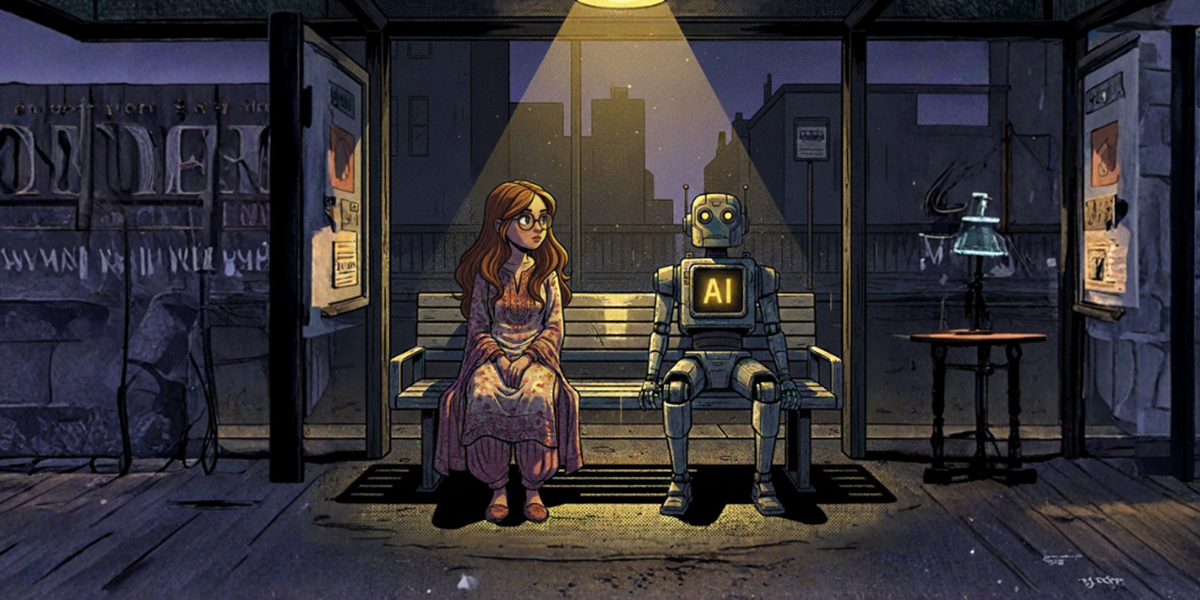
As far as my relationship with AI goes, we are now a toxic pair. I despise it and struggle to live without it. I use it while questioning it. I benefit from it while fearing its consequences. AI needs me for validation, to borrow my data, my language, my intent, and to present it anew under someone else’s prompt. In this uneasy dependency lies the real tension of our time.
Negotiating the Future of ‘I’
Maybe the future isn’t necessarily a fight between AI and ourselves, but more of a negotiation. Every day, we have to choose to be thinkers first and users second. If we let go of our own thinking completely, getting it back might be even more complicated than creating intelligence in the first place.