


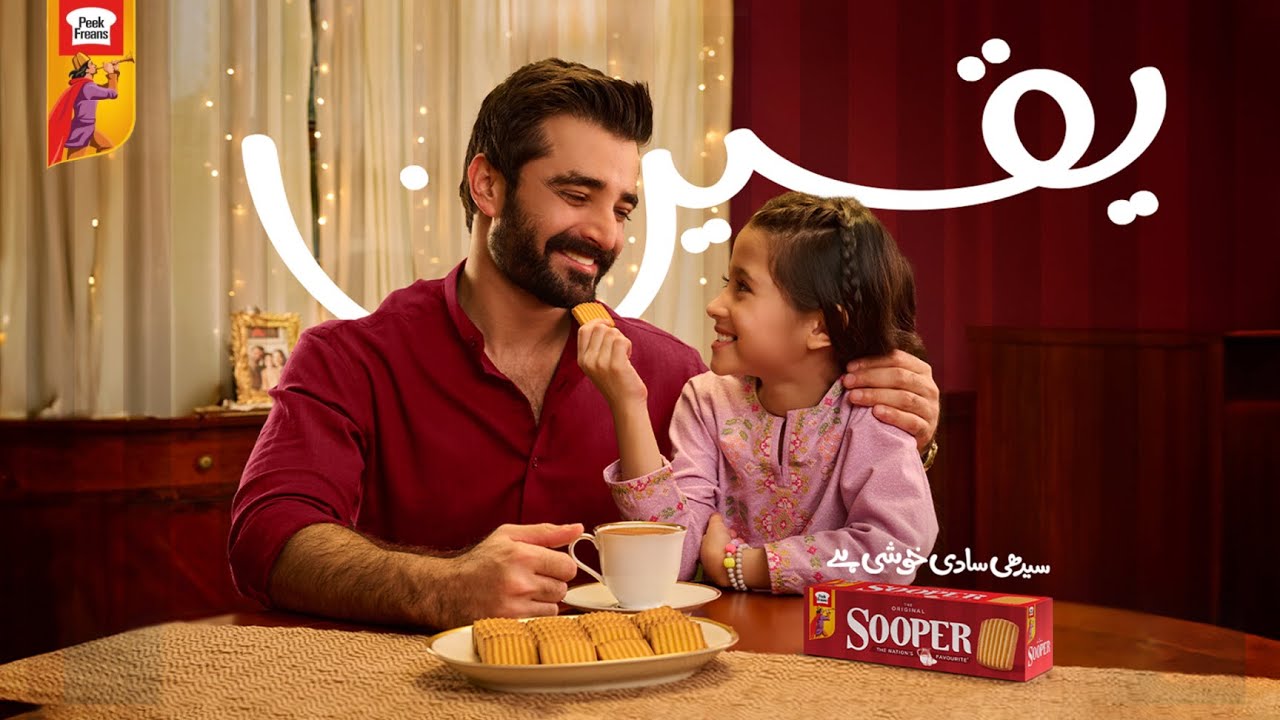
1. Peek Freans Sooper — Dil se Yaqeen ki Seedhi Saadi Khushi Hai Sooper
In a category that often defaults to nostalgia as shorthand, Peek Freans Sooper’s Ramadan film feels refreshingly unforced. The campaign doesn’t chase spectacle or over-script emotion. Instead, it leans into the quiet reassurance of routine, faith, and familiarity — ideas that feel deeply embedded in how Ramadan is actually lived rather than how it is typically dramatized.
What works culturally is the film’s restraint. It understands that simplicity is not a lack of ambition, but a value system. The storytelling mirrors everyday rhythms: shared meals, unspoken understanding, small gestures that carry weight because of repetition. The biscuit is present, but never intrusive — it behaves like it would in real life, not as a prop demanding attention.
Contextually, this approach feels timely. In a media landscape saturated with heightened emotion and performative piety during Ramadan, Sooper chooses to soften its voice. That tonal decision is strategic. It respects an audience that is already emotionally primed and doesn’t need to be told how to feel.
From a viewer’s standpoint, the ad succeeds because it feels recognisable. It doesn’t ask consumers to aspire upwards; it asks them to look around. By selling belief, continuity, and understated joy, the brand reinforces its long-standing position as a constant — not a momentary indulgence, but a quiet companion. The result is advertising that doesn’t interrupt Ramadan, but gently inhabits it.
2. The Citizens Foundation — Change the Gameboard — One Girl at a Time
TCF’s Change the Gameboard campaign stands out because it resists simplification in a space that often relies on emotional shorthand. Rather than framing girls’ education as charity or rescue, the film positions it as a strategy, a deliberate intervention that alters outcomes, not just narratives.
Culturally, this is an important shift. The campaign acknowledges the realities of early marriage and systemic barriers without sensationalizing them. By focusing on a single girl and the ripple effects of education, it reframes progress as something incremental yet transformative. The “gameboard” metaphor is particularly effective in a society where rules are often inherited rather than questioned; it suggests that systems can be learned and therefore changed.
Contextually, the film arrives at a moment when conversations around women’s agency in Pakistan are both urgent and contested. TCF doesn’t attempt to resolve that tension; it simply grounds the argument in possibility. Education is not positioned as a moral high ground but as practical foresight.
For the viewer, the emotional impact comes from clarity rather than overwhelm. There is no excess imagery, no dramatic score insisting on empathy. The film trusts its audience to connect the dots. In doing so, it sells an idea that long-term change begins quietly, one decision at a time, rather than soliciting immediate sympathy. It is advocacy that feels measured, confident, and deeply respectful of the intelligence of its audience.
3. Pepsi- Dil Dil Pakistan
Pepsi’s Independence Day campaign is less about the nation as a static symbol and more about national feeling as something that evolves. By tracing its own advertising history alongside Pakistan’s cultural shifts, the brand positions itself not as a commentator but as a participant, present through changing moods, music, and moments.
What works culturally is Pepsi’s understanding of emotional continuity. Dil Dil Pakistan isn’t invoked as nostalgia for a specific era, but as a recurring emotional thread that adapts with each generation. The film avoids the trap of romanticizing the past; instead, it acknowledges change as a constant. That makes the patriotism feel lived-in rather than performative.
Contextually, this is a smart response to a fragmented national sentiment. In a time when identity feels complex and sometimes contradictory, Pepsi doesn’t attempt to define patriotism. It reflects it. The brand becomes a mirror rather than a message, allowing viewers to project their own associations onto familiar cues.
From a consumer perspective, success lies in emotional ownership. The product never demands attention; it simply exists within moments that already matter. Pepsi isn’t selling a drink, it’s selling presence. The campaign reinforces the idea that relevance is earned through consistency and cultural fluency, not volume. In doing so, it demonstrates how legacy brands can remain contemporary without reinventing themselves every year.
4. KFC- Yaari KFC Wali
Yaari KFC Wali works because it understands that friendship, in the Pakistani context, is defined by intimacy rather than declaration. The film doesn’t dramatize bonds; it highlights the small, often unspoken markers of closeness, finishing sentences, knowing orders, and shared shorthand.
Culturally, the campaign taps into a universal truth: real friendships are built on familiarity, not grand gestures. By anchoring the narrative in everyday interactions, KFC aligns itself with moments of ease rather than excitement. The humor is understated, the performances natural, and the setting recognizable.
Contextually, this approach feels apt in a post-pandemic, socially fatigued environment where audiences crave relatability over aspiration. The brand positions itself as part of the group dynamic, not the center of it. Food becomes the backdrop to connection, not the reason for it.
From a viewer’s standpoint, the campaign is effective because it respects lived experience. It doesn’t exaggerate friendship to sell indulgence; it normalizes indulgence as part of friendship. The product appears as a shared constant, something everyone agrees on without discussion. In doing so, KFC sells a feeling of belonging rather than a menu item, reinforcing its place within social rituals rather than transactional consumption.
— — — — — —
Taken together, these campaigns point towards a broader creative shift, one where advertising in Pakistan is becoming less about persuasion and more about interpretation. The strongest work of the year doesn’t ask audiences to buy; it asks them to recognize themselves. Whether through faith, education, national identity, or friendship, these ads succeed by embedding brands within existing emotional ecosystems rather than constructing artificial ones.
These campaigns were not chosen because they are grand or technologically ambitious. They were chosen because, as a viewer and a consumer, they linger. They feel familiar without being formulaic and considered without being self-conscious. None of them rely on excess, not in production, not in messaging, and not in intent. What connects them is their ability to recognize that persuasion today often comes from identification rather than instruction. Each campaign understands its audience not as a demographic to be impressed, but as people navigating faith, friendship, identity, and aspiration in very real ways. The brands succeed by observing those realities closely and responding with restraint.
The opportunity moving forward lies in pushing this further, trusting nuance, embracing complexity, and resisting the urge to over-explain. The challenge for the next year will be consistency: ensuring that selling ideas does not become a stylistic choice but a sustained commitment to cultural understanding and emotional honesty. Not every campaign needs to be loud or groundbreaking, but it does need to feel honest. If advertising can continue to speak to people the way these films do, quietly, recognizably, and without urgency, it will remain relevant in ways that no tool or trend ever could.