

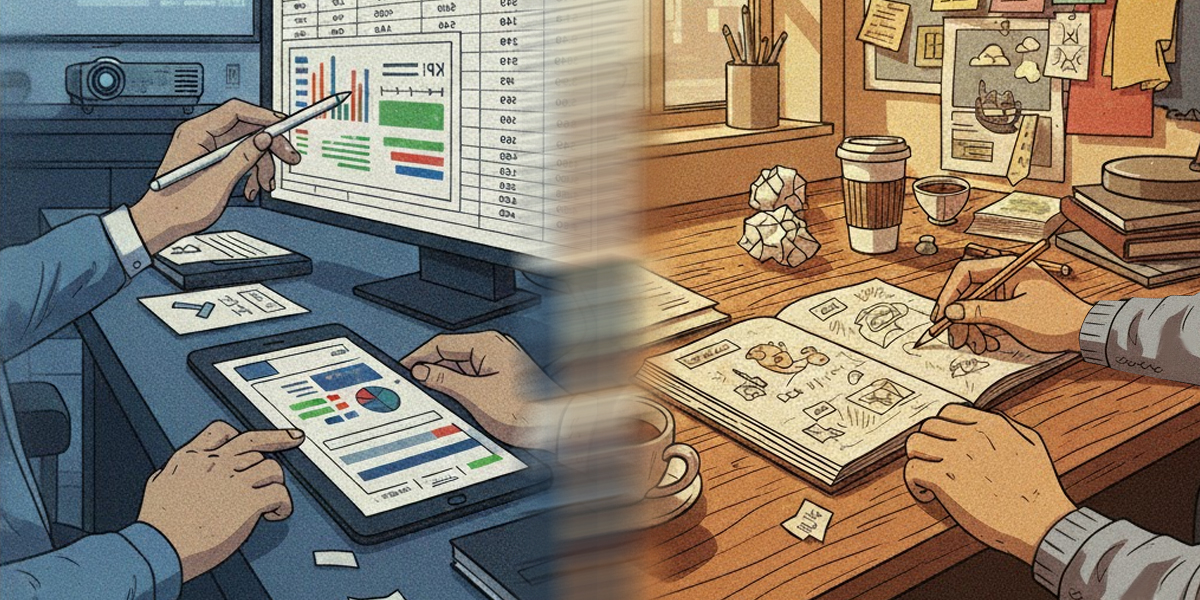
The tension between clients and creatives is often described as inevitable, as if misunderstanding is built into the relationship. But most friction doesn’t come from opposing goals. It comes from shared goals that are interpreted differently. The proverbial lost in translation that plays out day after day.
Same Goals, Different Interpretations
Clients and creatives usually want the same thing: work that delivers results and builds brands. What gets misunderstood is how that happens, what good work requires, and where responsibility begins and ends.
Clients often think creatives are selling taste: art over substance, awards over effectiveness. Creatives, meanwhile, think clients are buying results alone, prioritising short-term numbers over ideas, safety over bravery, and appeasing bosses over progress. The truth, of course, is more complex.
Creatives are not selling taste; they are selling judgment, the ability to decide what will connect with people before the data exists. And clients are not buying vanity; they are buying certainty and reassurance that risk will lead somewhere meaningful.
When this difference isn’t acknowledged, conversations become defensive instead of collaborative. Briefs are treated as instructions rather than invitations, to question objectives, clarify expectations, and sharpen intent.
Clients often see the brief as a set of instructions to be followed. Creatives see it as a starting point to be questioned, stretched, and sometimes challenged. This is where frustration begins. When creatives interrogate a brief, it isn’t resistance; it’s responsibility. And when clients expect adherence to the brief, it isn’t control; it’s accountability.
Misunderstanding arises when curiosity is mistaken for defiance, and structure is mistaken for limitation. Great work comes from briefs that invite thinking, not just compliance.
Where the Friction Really Comes From
Another thing frequently lost in translation is time, the time required to analyse problems and arrive at meaningful solutions. Speed is often confused with efficiency. In today’s environment, speed is prized: faster turnarounds, quicker content, shorter timelines.
Clients may equate speed with efficiency. Creatives know that speed without thinking is just movement, not progress. Some parts of creativity cannot be rushed. Insight, clarity, and idea formation take time, not because creatives are slow, but because good thinking needs space. When speed becomes the only metric, quality quietly disappears.
Risk, too, means different things to each side. To clients, risk is commercial, budgets, reputation, internal scrutiny, market response. To creatives, risk is cultural, relevance, credibility, being ignored. Both risks are real, yet rarely discussed openly. As a result, creatives push for boldness without fully appreciating the stakes, while clients pull back without explaining the pressures they face. The result isn’t disagreement, it’s misalignment. When risk is framed honestly, trust grows. When left unspoken, fear makes the decisions.
Clients often ask for simplicity: clearer messages, fewer ideas, sharper execution. Creatives worry that simplicity will flatten nuance and reduce impact. But simplicity and depth are not opposites. What’s misunderstood is that simplicity is the output, not the input. Depth is what allows simplicity to exist. When clients push for simplicity too early, creatives feel unheard. When creatives deliver complexity too late, clients feel overwhelmed. Timing matters.
At the altar of science, creativity often dies. Don’t get me wrong, I love data. Clients rely on data to reduce uncertainty. Creatives rely on intuition to navigate ambiguity. Misunderstanding occurs when data is treated as a final answer rather than a guide. Data can tell you what happened, not what could happen. Creativity lives in that gap. When data is used to shut down ideas instead of sharpening them, innovation stalls, and we fall back on cookie-cutter solutions built on “done-before” references. The best partnerships don’t choose between data and intuition; they let them challenge each other.
From Feedback to Feedforward
One of the biggest hurdles to creative and effective work is the “F word”, feedback. Feedback is often driven by fear rather than the work itself. When clients give vague or contradictory feedback, creatives may assume indecision or a lack of vision. More often, feedback is a proxy for fear, fear of internal reactions, misalignment, or failure.
Similarly, when creatives push back on feedback, clients may read arrogance when it’s often protectiveness over the integrity of the idea. What’s misunderstood is intent. Feedback improves when both sides talk about why they feel uneasy, not just what they want changed.
A client once introduced us to a better word than feedback, feedforward. It was an epiphany. Reframing feedback in terms of what moves the work forward, not backward, seems like a small shift, but it can make a huge difference.
Another way to unlock better feedback is to ask why, repeatedly. Change the colour. Why? Maza nahi aya. Why? Don’t like this direction. Why? The same “five whys” framework used to uncover insight should be applied to feedback. Creatives aren’t pushing back when they ask why, they’re pushing the work forward.
Ultimately, much of this comes down to ego. Creatives want trust. Clients want transparency. Creatives say, “Let us do what we do best.” Clients say, “Help us understand how you got there.” These are not conflicting needs, but they’re often treated as such. Trust doesn’t mean blind faith. Transparency doesn’t mean creative dilution.
When creatives explain their thinking clearly, trust increases. When clients share their constraints honestly, transparency deepens. The relationship stops being transactional and becomes collaborative.
Perhaps the most fundamental misunderstanding is this, both sides forget they’re on the same side.
Clients see agencies as vendors. Agencies see clients as obstacles. But the strongest work comes from shared ambition, shared accountability, and shared pride in the outcome. Misunderstandings won’t disappear overnight, but they’ll be resolved faster, with less ego and more respect.
Creatives need to understand commercial pressure. Clients need to understand the creative process. Both need to respect each other’s expertise.
Misunderstanding thrives in silence. Alignment grows through conversation. The best work is built together, not fought over from opposite sides. The most successful client–creative relationships aren’t defined by fewer disagreements, they’re defined by better ones. When both sides stop assuming intent and start asking questions, what gets misunderstood becomes what gets built together.
Atiya Zaidi is CCO, CEO, BBDO Pakistan.