


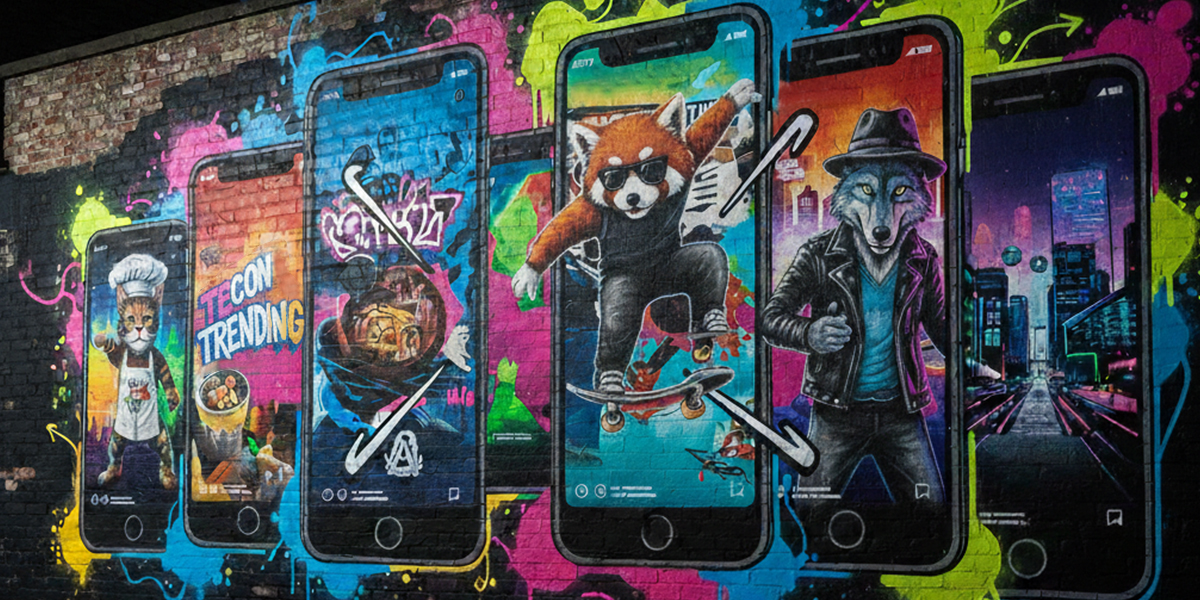
Not long ago, stories stretched horizontally. Films, photographs, and even our collective imagination leaned wide. Landscapes mattered. Silence mattered. Time had room to breathe. Then the phone stood upright, and everything followed.
Vertical reels did not just change how we consume content. They quietly began to shape how we think.
The 9:16 frame is no longer a format. It is a worldview.
We now experience ideas in slices. One face, one punchline, one emotion at a time. Context is cropped out. Background becomes irrelevant. The world narrows, literally, to whatever fits between two thumbs. And as this format dominates our feeds, a question becomes unavoidable: are we still thinking freely, or are we thinking in frames?
When content is designed to fill a vertical screen, thought itself adapts to survive inside it. Ideas must be fast, expressive, and instantly legible. There is little patience for build-up or ambiguity. A reel has seconds to prove its worth before the next swipe erases it. As a result, nuance often becomes collateral damage.
Vertical reels reward certainty. Strong opinions travel better than complex ones. Extremes outperform balance. Emotion outpaces reflection. In a space where attention is the currency, the loudest feeling usually wins. This doesn’t mean creators are shallow. It means the environment quietly trains them to compress their thinking into something scroll-stopping.
So what gets lost when everything becomes 9:16?
Scale, for one. The horizontal frame allowed us to situate people within environments, ideas within systems, moments within time. Vertical reels isolate. They turn stories into close-ups. The result is intimacy, yes, but also detachment. We see faces without places, reactions without reasons, outcomes without process.
Time is another casualty. Vertical content thrives on speed. There is little room for discomfort, pauses, or silence. Yet those are often the spaces where deeper understanding forms. When everything must move fast, we forget that some ideas need slowness to exist at all.
Then there’s memory. Reels are designed to be consumed and discarded. They blur together, creating a constant present with no past. We remember the feeling, rarely the message. This changes how knowledge is absorbed. We feel informed but struggle to recall what we actually learned.
Which brings us to the most uncomfortable question: are we creating for people, or for algorithms?
The algorithm loves predictability. It rewards patterns, formats, hooks that have worked before. Over time, this subtly nudges creators toward sameness. Original ideas still exist, but they are often dressed in familiar clothing so they can pass the algorithm’s gatekeeping.
Creators begin to ask different questions. Not “Is this meaningful?” but “Will this perform?” Not “Does this need time?” but “Will people wait?” The algorithm does not care about truth, depth, or cultural impact. It cares about retention, completion rates, and repeatability.
This doesn’t make creators dishonest. It makes them adaptive.
Yet when an entire creative ecosystem optimizes for the same signals, culture starts to flatten. We don’t lose creativity altogether. We lose risk. We lose the odd, the slow, the unresolved.
And still, vertical reels are not the villain.
They have democratized storytelling. They have given voice to people who were never handed a microphone before. They have made creativity accessible, immediate, and participatory. The problem is not the format. The problem is forgetting that it is a format.
The danger begins when we confuse what performs well with what matters. When we assume that if an idea doesn’t fit 9:16, it doesn’t deserve space.
Perhaps the real challenge is balance. Using vertical reels as a tool, not a ruler. Creating content that respects the audience’s intelligence, not just their attention span. Remembering that humans think in layers, not just frames.
Because if format continues to shape thought unchecked, we may wake up one day fluent in scrolling but struggling to think beyond the screen.